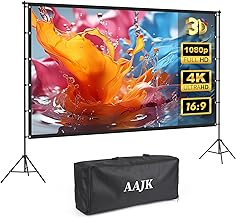
Setting up a dedicated home theater or planning an epic backyard movie night requires careful consideration of two critical components: the projector and the movie screen. While premium, high-end systems like the hypothetical “CinemaMax 3000” promise unparalleled quality, they often come with a prohibitive price tag and complex installation requirements. Fortunately, the market is rich with excellent alternatives that deliver stunning visuals without breaking the bank or requiring professional contractors.
This guide dives deep into finding the perfect balance of performance and practicality, exploring five top alternatives to high-cost projector and movie screen combinations. Whether you prioritize portability for camping trips, ambient light rejection for a bright living room, or simply the largest possible image for the lowest price, we have options that fit your specific needs and budget.
Why Seek Alternatives to Premium Projector Setups?
The allure of a top-tier, permanently installed projector and movie screen system is strong, offering cinema-grade immersion. However, these systems often introduce challenges that make them impractical for the average user.
Cost vs. Performance Trade-offs
High-end screens, particularly those featuring advanced Ambient Light Rejecting (ALR) technology or motorized tension systems, can cost thousands of dollars alone. When paired with a premium 4K laser projector, the total investment can easily exceed the cost of a high-end large-format television. For many consumers, the marginal increase in performance offered by these expensive components does not justify the massive financial outlay. Affordable alternatives today offer excellent 4K readiness and high gain surfaces that provide fantastic image quality under controlled lighting conditions.
Portability and Installation Needs
Many modern home entertainment needs demand flexibility. A fixed-frame projector and movie screen setup is great for a dedicated media room, but it fails if you want to move the fun outdoors, to a friend’s house, or even to a different room. Alternatives often focus heavily on portability, offering lightweight materials, quick setup stands, and foldability, making them ideal for dynamic viewing environments. This flexibility is a key factor when evaluating the true value of a complete projection system.
Top 5 Projector and Movie Screen Alternatives
We have selected five diverse alternatives that cater to different budgets, space requirements, and usage scenarios, providing a high-quality projection surface without the premium price tag associated with top-of-the-line models.
Alternative 1: The Budget-Friendly Fabric Screen
For users prioritizing a large image size on a shoestring budget, a simple, foldable fabric screen offers incredible value. These screens are typically made from anti-crease polyester material, designed to be hung from a wall or frame.
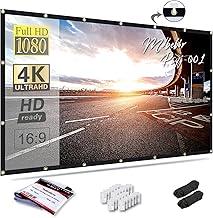
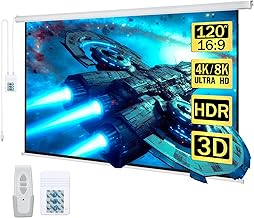
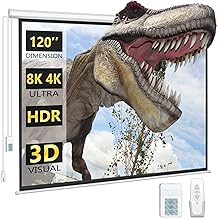
The Mdbebbron 120 inch Projector Screen (B07FB6VW1M) exemplifies this category. It’s a massive 120-inch screen that folds down easily for storage. While it lacks a rigid frame, its anti-crease material ensures a relatively flat surface when properly stretched. This type of screen is perfect for pairing with a standard entry-level 1080p or even a budget 4K projector, offering a huge cinematic experience for minimal investment.
Ideal Use Case
This is the best option for occasional movie nights, classroom use, or situations where the screen needs to be stored away immediately after use. It’s highly portable and can be set up almost anywhere with hooks or ropes. It is an excellent, low-cost solution for anyone needing a large movie screen without needing a heavy, permanent installation.
Alternative 2: The Portable Stand Solution
When portability is key, but you still need a stable, wrinkle-free surface that doesn’t rely on existing wall fixtures, a screen bundled with its own stand is the ideal choice. These kits bridge the gap between permanent installation and simple fabric sheets.
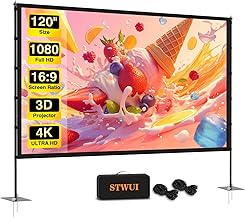
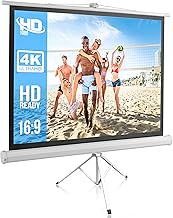
Consider the Outdoor Projector Screen with Stand (B0DGBXPKMW). This 120-inch model comes complete with a sturdy, lightweight frame, making setup quick and easy in a backyard, garage, or large indoor space. The inclusion of the stand means the projection surface is taut and perfectly framed, maximizing the clarity and impact of the image from your projector.
Key Features and Portability
These models typically feature a 16:9 aspect ratio optimized for modern movie and television content. Their design often includes ground stakes or weighted bags to ensure stability outdoors. The entire assembly usually breaks down into a compact carry bag, making it a true grab-and-go solution for mobile entertainment. This type of projector and movie screen combo is perhaps the most versatile alternative for family entertainment.
Alternative 3: The Luxury UST/ALR Screen
If your budget allows for a higher-quality screen, but you still want an alternative to a traditional, bulky home theater setup, an Ambient Light Rejecting (ALR) screen designed for Ultra Short Throw (UST) projectors is a game-changer. These screens are specifically engineered to reflect light coming from below (where a UST projector sits) directly back to the viewer, while absorbing light coming from above (ambient room light).
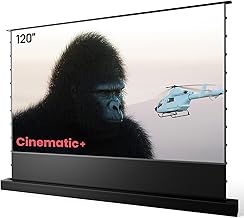
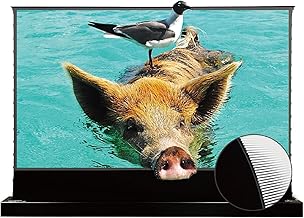
The AWOL VISION 120″ Motorized ALR Floor Rising Projector Screen (B0CXJ1XBQG) is a premium alternative to wall-mounted fixed screens. It rises from a sleek floor-standing cabinet, disappearing when not in use. This offers the aesthetic cleanliness of a traditional TV while providing a massive 120-inch image, even in a moderately lit room. It is a dedicated solution for those investing in a high-end UST projector but who cannot or do not want to mount a screen permanently on the wall.
Ambient Light Rejection Explained
ALR technology dramatically improves contrast and color saturation by minimizing the impact of ceiling lights or daylight. This makes the image look crisp and vibrant, even during the day, effectively eliminating the need for a pitch-black room—a common limitation of standard matte white movie screen surfaces. While this alternative is costly, it replaces the need for complex in-wall wiring and ceiling mounts often required by long-throw projectors.
Alternative 4: The Inflatable Giant
When maximum size and ease of outdoor setup are the primary goals, inflatable screens are the ultimate fun alternative. These screens utilize an internal fan to inflate a large frame, creating a truly massive projection surface suitable for large gatherings or community events.
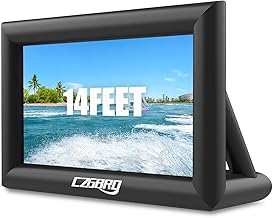
The Inflatable Projector Screen (14FT Outdoor Movie Screen) (B097233HSY) provides a spectacular canvas. At 14 feet, this screen turns any backyard into a genuine drive-in experience. It typically includes the air blower needed for rapid inflation and supports both front and rear projection, adding flexibility to your setup depending on where you need to place your projector.
Setup and Storage Considerations
While massive when deployed, inflatable screens deflate quickly and pack down into a relatively small storage bag. Setup usually takes less than five minutes. However, users should note that they require continuous power for the blower and are best suited for calm weather conditions, as wind can easily destabilize them, even with tie-downs. This is an excellent alternative for those who frequently host large outdoor movie events and need a quick, enormous movie screen.
Alternative 5: The Classic Tripod Mount
For smaller, more intimate settings, or for professional use where mobility and height adjustment are necessary, the classic tripod-mounted screen remains a reliable and cost-effective alternative. These screens offer a simple pull-down mechanism and a stable base.
The Pyle 50 Inch Portable Projector Screen with Tripod Stand (B01953VSH6) is a perfect example of this functional design. While smaller at 50 inches, its compact size makes it highly portable and ideal for quick setups. It often features a 4:3 aspect ratio, making it versatile for both older media content and business presentations, though 16:9 versions are also widely available.
Best for Presentations and Small Spaces
The tripod stand allows for variable height adjustment, ensuring the screen can be perfectly aligned with the projector regardless of the floor surface. The matte white fabric provides a clear, high-contrast image suitable for dark rooms. This alternative is favored by educators, traveling business professionals, and apartment dwellers who need a compact, high-quality projector and movie screen solution that can be set up in minutes and stored in a closet.
Choosing the Right Projector and Movie Screen Combo
Selecting the perfect projector and movie screen combination involves more than just picking a size. Understanding key technical specifications ensures you maximize image quality and get the best value from your purchase.
Understanding Gain and Viewing Angle
The “gain” of a screen refers to its reflectivity. A screen with a gain of 1.0 reflects all light equally across all viewing angles. Higher gain screens (e.g., 1.5 or 2.0) amplify brightness but typically narrow the viewing cone. This means viewers sitting directly in front of the screen see a brighter image, while those seated far to the side may see a dimmer picture.
For large, casual gatherings (like backyard movie nights using a portable screen with stand), a gain closer to 1.0 or 1.1 is often preferred, ensuring a wide viewing angle. For dedicated, dark home theaters, a slightly higher gain might be acceptable, or an ALR screen (like Alternative 3) might be used to enhance contrast without sacrificing too much viewing angle.
Screen Material Types (Matte White vs. ALR)
The screen material dictates performance, especially in ambient light conditions:
- Matte White: This is the most common and affordable material (found in Alternatives 1, 2, 4, and 5). It provides a neutral, accurate color reproduction and a wide viewing angle. However, it performs poorly in rooms with uncontrolled light, as ambient light washes out the image.
- Ambient Light Rejecting (ALR): These screens use specialized optical layers to selectively reflect light, dramatically improving contrast in brighter environments (Alternative 3). They are often necessary for living room setups where light control is impossible.
- Rear Projection: Some screens (like the inflatable option, Alternative 4) allow the projector to be placed behind the screen, useful for tight spaces or when you want the projector hardware hidden from the audience.
Aspect Ratio (16:9 vs. 4:3)
The aspect ratio determines the shape of the image:
- 16:9 (Widescreen): This is the standard ratio for modern HDTV, Blu-rays, and streaming content. It is the best choice for a dedicated movie theater or entertainment space. Most modern projector and movie screen combinations use this ratio.
- 4:3 (Standard/Square): This older format is useful primarily for business presentations, educational content, or older video formats. If your main use is cinema, stick to 16:9.
Maximizing Your Projector and Movie Screen Experience
Choosing the right hardware is only half the battle. Optimizing your environment ensures that your chosen alternative performs to its full potential.
Acoustics and Sound Integration
A massive movie screen demands equally impressive sound. While many modern projectors have built-in speakers, they are often insufficient for a true cinematic experience. Consider integrating a dedicated sound system:
- Soundbars: Easy to set up and often offer virtual surround sound, perfect for portable setups.
- Dedicated Speakers: For permanent or semi-permanent setups, bookshelf speakers or floor-standing units positioned around the screen offer superior fidelity.
- Acoustically Transparent Screens: While a premium feature, some high-end screens allow speakers to be placed directly behind the screen material, making the sound appear to come directly from the actors on the screen.
Projector Placement and Throw Distance
The placement of your projector directly impacts the image quality and size. Always check the projector’s throw ratio—the distance required to project an image of a certain size.
- Standard Throw: Requires significant distance (often 10–15 feet) to fill a large movie screen.
- Short Throw: Can project a large image from just a few feet away, ideal for small rooms.
- Ultra Short Throw (UST): Sits directly beneath the screen (as required by Alternative 3), eliminating shadows and simplifying cable management.
When using a portable projector and movie screen with a stand, ensure the stand height and projector placement are adjustable to correct for keystone (trapezoidal distortion) and focus.
Installation and Maintenance of Your Alternative Screen
Even alternatives require proper setup and care to maintain peak performance.
Setup Tips for Portable Screens
For foldable or stand-mounted screens (Alternatives 1, 2, 5):
- Wrinkle Removal: If your foldable fabric screen has creases (common with Alternative 1), gently stretching the material or using a low-heat steamer can help flatten the surface before projection.
- Stability: When setting up an outdoor projector and movie screen with a stand (Alternative 2), always use stakes or sandbags to secure the frame, preventing movement from wind gusts.
- Leveling: Ensure both the screen and the projector are perfectly level to avoid geometric distortion and maximize image sharpness.
Caring for Screen Material
Regardless of the type of movie screen you choose, maintenance is crucial:
- Cleaning: Use a soft, lint-free cloth and mild soap (if necessary) to clean the screen surface. Never use harsh chemicals or abrasive materials, especially on delicate ALR surfaces, as this can damage the optical layers.
- Storage: When storing foldable screens, roll them tightly or fold them along the factory creases to minimize new wrinkles. Keep them in a cool, dry place away from direct sunlight.
Conclusion
You don’t need the most expensive, top-of-the-line “CinemaMax 3000” setup to enjoy a spectacular cinematic experience. The market offers a fantastic range of projector and movie screen alternatives tailored to every budget and environment. Whether you opt for the ultimate portability of a simple fabric screen, the stability of a stand-mounted system, the daytime performance of an ALR model, or the sheer fun of an inflatable giant, there is a perfect pairing waiting to transform your viewing experience.
By carefully considering factors like screen gain, material, and portability, you can select an alternative that provides exceptional image quality and maximum enjoyment for years to come.